

Growing a Facebook page from 5 to more than 8,000 followers in under three months was a strong result.
But followers were never the only goal.
Behind that number was market research, testing different audiences and campaign objectives, studying the results, and continuously adjusting the strategy to match changing business goals.
The Starting Point
The client was a B2B trading company selling a range of products. For this project, much of the advertising focused on Mazafati dates and reaching potential buyers in international markets.
When we started, the company’s Facebook page had only 5 followers.
But the challenge was bigger than a follower count.
The company needed to reach potential customers in the right markets while still learning which countries and audiences would respond.
This raised an important question:
Where was the actual demand, and where could Facebook realistically reach those potential buyers?
Research Before Advertising
Before launching the campaigns, we looked at the international market for Mazafati dates.
Demand for the product was not the same everywhere, so targeting as many countries as possible wouldn’t have been a smart use of the advertising budget.
We identified countries where there appeared to be stronger demand for Mazafati dates and then considered which of those markets we could realistically reach through Facebook advertising.
This gave us an initial group of target markets.
But research was only the starting point.
Once the campaigns began, real performance data could show us which markets were actually responding and help us refine the targeting further.
Testing the Markets
Once the campaigns started running, we began to see how different markets responded to the ads.
Some countries generated strong engagement and useful responses. Others showed much less activity.
This gave us something research alone couldn’t:
real evidence.
We learned that demand for a product does not always translate into a strong response to an advertisement.
That information helped us decide where the advertising budget could be used more effectively.
Adjusting the Strategy
As the results came in, we adjusted.
Markets with weaker responses received less budget, while markets producing stronger responses received more attention.
It wasn’t a fixed plan created on day one and left unchanged.
We continued refining the targeting as we learned more.
The client’s goals also changed during the project. At different times, the focus included generating inquiries, increasing page visits, and growing the Facebook audience.
The campaigns changed with those goals.
When campaigns generated potential customer inquiries, we also helped manage those leads and passed relevant prospects to the sales team.
One Campaign Result
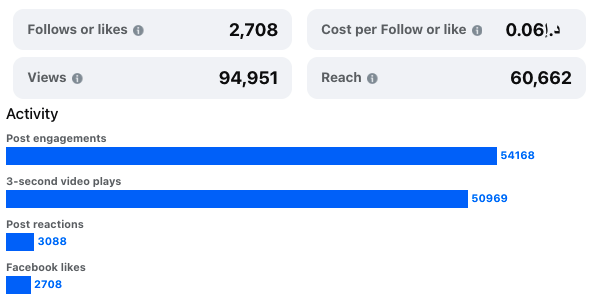
One campaign focused specifically on growing the Facebook page generated:
2,708 follows or likes
at a cost of:
AED 0.06 per result
The campaign also reached 60,662 people and generated 94,951 views.
This was one campaign within the wider project, so these numbers should not be confused with the total results of all campaigns.
The Overall Result
Across the project, while testing different markets, changing objectives, studying performance, and adjusting the campaigns, the Facebook page grew from:
5 followers → 8,000+ followers
in under three months.
The follower growth is easy to show as a number, but the more important part of the project was the process behind it.
Our Approach
This project was built around a simple principle:
Research → Test → Measure → Adjust
Research gave us a starting point, but campaign data guided the decisions that followed.
As we learned which markets and audiences responded, we adjusted the targeting, budget, and campaign objectives. When the client’s priorities changed, the campaigns changed with them.
Rather than following one fixed plan, we used real performance data to decide what to do next.